

Description
### Introduction
Eritrean traditional 24K gold wedding jewelry sets are far more than decorative accessories—they are living testaments to the country’s ancient heritage, cultural diversity, and enduring family bonds. For centuries, these handcrafted pieces have been central to Eritrean wedding rituals, symbolizing love, protection, and the transmission of history from one generation to the next. Unlike mass-produced jewelry, each set tells a story: of Axumite craftsmanship, interfaith influences, and the quiet resilience of Eritrean communities. Whether worn in a village wedding outside Asmara or a diaspora celebration in Addis Ababa, these 24K gold necklaces, earrings, rings, and bracelets remain a cherished link to the nation’s identity.
### Historical Roots: Axumite Legacy and Gold’s Timeless Value
Eritrea’s gold jewelry tradition traces its origins to the **Axumite Empire** (100 BCE–700 CE), a powerful civilization that spanned modern-day Eritrea, Ethiopia, and parts of Yemen. Axumites were renowned for their mastery of gold working—they traded gold with Egypt, Rome, and India via the Red Sea, and their artifacts (including gold crowns and amulets) still survive in museums worldwide.
After the Axumite decline, the craft evolved under Islamic and Christian influences. Eritrea’s diverse religious communities (Orthodox Christians, Muslims, Catholics, and Protestants) adapted Axumite techniques to reflect their beliefs: cross pendants for Christians, geometric motifs (representing unity and fertility) for all groups, and inscriptions of Quranic verses for Muslim families.
24K gold became the preferred material for wedding sets for three key reasons:
1. Its purity (99.9% gold) means it does not tarnish, symbolizing enduring love.
2. It is hypoallergenic, making it safe for daily wear long after the wedding.
3. It was historically a sign of wealth and respect, reflecting the family’s commitment to the union.
### Key Elements of the 24K Gold Wedding Set
Each piece in the traditional set serves a distinct cultural purpose, with designs rooted in local symbolism:
#### 1. Necklace (Shimel or Meqdesh)
The necklace is often the centerpiece of the set, with two common styles:
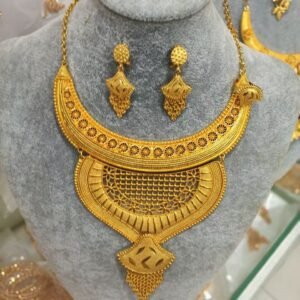
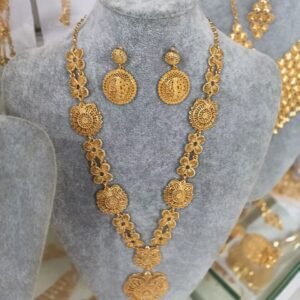
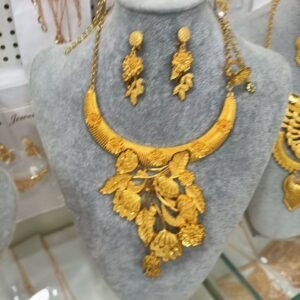
– **Long Chain (30–36 inches):** Worn over the wedding dress, it features a central pendant—either a cross (for Orthodox Christians), a geometric shape (like a triangle, symbolizing family), or a *telsum* (amulet with protective inscriptions). Some necklaces are layered with shorter chains for added elegance.
– **Meqdesh (Holy Necklace):** Reserved for Christian weddings, this necklace includes a small cross and tiny charms representing saints or biblical figures. It is blessed by a priest before the ceremony, imbuing it with spiritual protection.
#### 2. Earrings (Kollay)
Kollay (Tigrinya for “earrings”) are large, dangling pieces with intricate filigree work. They often include small gold beads or carnelian stones (a red gemstone native to Eritrea, symbolizing love and vitality). The length of the earrings varies—longer styles (up to 4 inches) frame the bride’s face, while shorter ones are paired with elaborate hairstyles. For many families, kollay are heirlooms passed down from grandmothers to brides, connecting the couple to their ancestors.
#### 3. Ring
The traditional wedding ring is a simple 24K gold band with subtle engravings (geometric lines, tiny crosses, or floral patterns). Some rings feature a single carnelian stone set in the center, while others are plain to emphasize purity. During the ceremony:
– For Christians, the ring is exchanged during the *kiddush* (blessing) ritual, placed on the bride’s right hand (later moved to the left after the ceremony).
– For Muslims, it is part of the *nikah* (marriage contract), gifted by the groom to the bride as a sign of commitment.
#### 4. Bracelet (Sibhat)
Sibhat (Tigrinya for “bracelet”) is a delicate piece made of linked gold beads or filigree chains. It is usually worn on the left wrist (associated with the heart) and symbolizes unity between the couple. Some bracelets include a small charm—like a key (representing the home they will build) or a star (symbolizing guidance). Like other pieces, sibhat are often passed down, with each scratch or mark telling a story of past weddings.
### Craftsmanship: Handmade Techniques Passed Down for Centuries
Eritrean goldsmiths (called *Sebhaty* in Tigrinya) use traditional hand tools and techniques that have changed little since Axumite times. Key practices include:
– **Filigree:** Thin gold wires are twisted into intricate patterns (like lace) and soldered together. This technique requires extreme precision—artisans often use tweezers and small torches to shape the wires.
– **Granulation:** Tiny gold beads (0.5–1mm) are applied to the surface of the jewelry to create texture. This Axumite technique was once lost but has been revived by modern artisans.
– **Hand-Hammering:** Gold sheets are hammered into desired shapes, giving the jewelry a unique, uneven texture (unlike machine-made pieces). Hammering also strengthens the soft 24K gold, making it more durable.
Each piece takes hours to make: a filigree necklace can take 2–3 days, while a simple ring may take 4–6 hours. Artisans source gold from local mines (Eritrea has significant gold deposits in the Northern Red Sea region) or recycled gold from old family jewelry, ensuring authenticity and sustainability.
### Cultural Significance in Weddings
The 24K gold set plays a central role in Eritrean wedding rituals:
– **Dowry and Gift Exchange:** The set is often part of the *tilet* (dowry) gifted by the bride’s family to the groom’s family, or vice versa. It is a tangible sign of the family’s respect for the union and their commitment to supporting the couple.
– **Ceremonial Wearing:** The bride wears the full set during the wedding day—from the morning preparation (where female relatives help her dress) to the evening reception. For some communities, the groom may also wear a small gold bracelet or ring.
– **Heirloom Transmission:** After the wedding, the set is passed down to the couple’s daughters, ensuring that the family’s history lives on. Many brides wear a combination of new pieces and heirlooms, blending tradition with modernity.
### Modern Relevance: Preserving Heritage in a Changing World
Today, Eritrean couples—both at home and in the diaspora—still prioritize traditional 24K gold sets for their weddings. Some adaptations include:
– **Blending with Modern Styles:** Brides may pair the traditional set with a simple gold watch or modern hair accessories, but the core pieces remain unchanged.
– **Custom Orders:** Diaspora families often order custom sets from Eritrean artisans, specifying designs that reflect their personal stories (e.g., a pendant with their wedding date).
– **Cultural Festivals:** Traditional jewelry is showcased at events like the Eritrean Independence Day Festival and the Asmara Cultural Fair, attracting tourists and buyers from around the world.
Despite the rise of mass-produced jewelry, Eritreans value the authenticity of handcrafted 24K gold sets—they see them as a way to keep their heritage alive in an increasingly globalized world.
### Preserving the Craft: Challenges and Initiatives
Eritrean goldsmiths face several challenges to keeping the tradition alive:
– **Competition from Mass-Produced Jewelry:** Cheap, machine-made gold jewelry (often 18K or lower) is more affordable, but it lacks the cultural significance of handcrafted pieces.
– **Skill Transmission:** Younger generations are often drawn to modern careers, so fewer are learning the time-consuming craft of goldsmithing.
– **Gold Price Fluctuations:** Global gold prices can make it difficult for artisans to source materials affordably.
To address these issues, several initiatives have emerged:
– **Vocational Training:** The Eritrean government offers goldsmithing courses in vocational schools, teaching young people traditional techniques and business skills.
– **Artisan Cooperatives:** Groups like the Eritrean Goldsmiths Association support artisans with access to materials, market access, and fair pricing.
– **Cultural Preservation Projects:** Organizations like the Eritrean Heritage Foundation work to document traditional jewelry designs and train artisans in reviving lost techniques (like granulation).
### Conclusion
Eritrean traditional 24K gold wedding jewelry sets are more than beautiful accessories—they are a window into the nation’s soul. Rooted in Axumite history, shaped by cultural diversity, and passed down through generations, these pieces symbolize love, resilience, and the enduring power of heritage. Whether worn in a village wedding or a diaspora celebration, they remind Eritreans of their identity and the stories that bind them together. As long as artisans continue to hammer, twist, and solder gold by hand, this tradition will remain a cherished part of Eritrean life for years to come.
Reviews
There are no reviews yet.